

“Oh, that’s gross!! Look at that poor caterpillar, what is all that white stuff on it’s back. What’s wrong with it?”
This caterpillar is known as a Catalpa worm which is the larval stage of the Catalpa Sphinx Moth. The primary host of the Catalpa worm (sometimes known as Catawba Worm) is the catalpa tree. The worm is bright green and yellow colored with a “horn” on the rear of its abdomen. The horn is not poisonous but is there to scare off potential predators. The Catalpa worm is valued by freshwater fishermen as bait. Generally, the Catalpa Worm is not considered a significant, or threatening pest of the tree. Though they can defoliate a tree in large enough numbers the tree will quickly recover and thrive, even with regular defoliation events.
The catalpa tree is a common species in Central Virginia and the Shenandoah Valley. It produces large heart shaped leaves and has clusters of white blooms in the spring. These blooms produce large “bean pods” which can be as long as 12-14 inches and are stiff. These blooms change from green to brown in the fall. Often these trees are called “cigar trees” or “bean trees” trees because of this pod.
So what is that white stuff on the worm?
It looks weird and painful. These are the pupae or cocoon of a parasitic wasp from the braconid family. These are small, stingless wasps which lay their eggs on the caterpillar and the young larval stage enters the caterpillar and feeds on it until the wasp reaches the size to pupate into an adult. The surprising thing is that the caterpillar will survive the infestation until the wasp pupates, at which time the caterpillar dies.
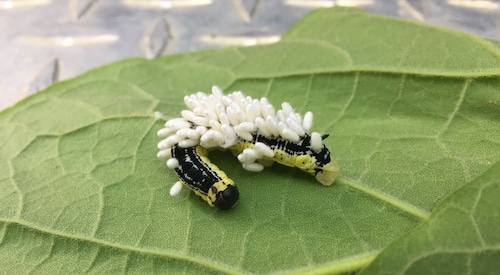
This wasp is one of many similar types of wasps which infest insects. They are a natural control measure for many of our more prominent pests. These beneficial insects are seen around the world and are often raised and introduced into a landscape as a biological control. The current war against invasive insects has increased the understanding and search for these insects to suppress invasive pests such as the Emerald Ash Borer.
Beneficial insects are common and active in the landscape. They help suppress the population of many insects that damage plants. This keeps the damage to a minimum and gives the plants a chance to grow and prosper. Many of these insects are attracted by a variety of flowering plants and shrubbery. Therefore, just as many of you are adding plants to your landscape which benefit pollinators, it is also a good idea to add those plants that benefit these special insects.
Our landscapes are a complex web of plants, insects, other arthropods, worms, bacteria and fungi. To maintain a healthy landscape it is important to understand this system exists and can be encouraged and fostered. By doing these things, your landscape will be healthier allowing it to thrive.
Why do i have bunch of dead catalpa worms hanging on leaves,have not seen that many red wasp around,dont spray trees,???????.