
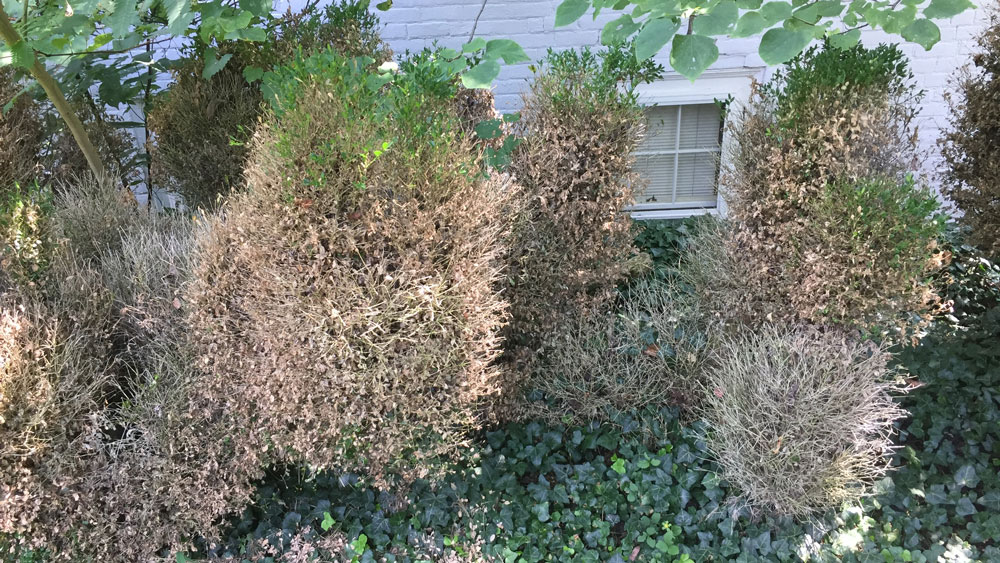
There is a new, devastating disease in our area known as Boxwood Blight. This disease is caused by a fungus and is a serious, aggressive, and destructive disease affecting boxwoods. It was originally introduced into the US in Connecticut and has spread to Virginia, first reported in Carroll County in 2011.
This disease was identified in 2016 at the Woodrow Wilson Birthplace in Staunton, Virginia. The Birthplace worked to remove all the affected plants and for the last two years appeared to be successful in stopping the spread of the disease. However, late this summer several properties near the Birthplace began showing signs of stress and leaf loss on the boxwoods in the landscape. These plants were tested and confirmed to have Boxwood Blight.
Boxwood Blight is spread by spores which attach to leaves, cuttings, clothing and anything else that comes in contact with the affected plant. The spores are also spread by being splashed onto the plant when it rains. The experts at Big O believe the disease was spread into these landscapes by animals such as squirrels, deer and more.
Fungal disease flourish in wet, rainy, high humidity conditions and this disease is no exception. This seasons heavy rains contributed to the spread of the disease providing the best condition for an epidemic outbreak.
All boxwood varieties are susceptible to this disease but especially the English Boxwood and the common American Boxwood are highly susceptible. This disease progresses rapidly once it infects the plant and there is very little that can be done at that point. There is currently no cure for the disease. This means the best option to preserve your boxwoods is prevention.
Boxwood Blight Prevention
Prevention includes keeping the spore away from your plants which can be very difficult. Be very careful this time of year about the greenery you use for Christmas decorations. Make sure they do not include boxwood clippings from plants not on your property. Stay clear of other landscape boxwoods to prevent introduction of the disease. If you have landscape companies working on your property, insist that they disinfect their tools before they come to your property.
If you see signs of leaf spot, leaf loss or decline, call for an inspection and assessment. You can also send samples to Virginia Cooperative Extension service for analysis.

Big O Tree’s Recommendation
Our team recommends to remove and dispose of all affected boxwoods. This includes the removal of all brush, dropped leaves, stumps and roots to reduce the risk of spreading of the disease. Bag debris and take to the dump to prevent further spread of Boxwood Blight. Do not keep the brush on your property if you have other healthy boxwoods you wish to preserve. Do not plant boxwoods back in the area that are not resistant to the disease.
If you have healthy boxwoods in your landscape you wish to preserve, preventative fungicide treatments through out the growing season may help. We recommend these treatments be applied every 2-3 weeks when temperatures are above 60 degrees and rain is in the forecast. These treatments are affective but will become costly over time. You will need to make some critical and difficult choices about the future of your landscape.
This is a new, aggressive and deadly disease which is going to radically change Virginia landscapes. The speed at which this disease spread in Staunton and the devastating results has been shocking. This is going to be one of the worst disease issues in the landscape we have ever seen.
Contact us if you would like to have your plants inspected and a program developed to treat. Big O Tree and Lawn Service is equipped and skilled at treating plant diseases. Our team of experts are staying at the forefront of this disease!

Gloomy Scale: The Silent Killer of Maple Trees
Have you noticed your beautiful maple trees looking shabby and lackluster? Maybe you've observed the canopy is thinning, early leaf loss, black sooty mold covered bark, or branch dieback. You may be...

Celebrating National Arbor Day
Caring for the Trees That Care for Us April is a time of renewal, growth, and fresh beginnings—and it’s also when we celebrate National Arbor Day. This special day is dedicated to recognizing the...

Why Spring Plant Care Matters
Why Spring Plant Care Matters: Setting Your Landscape Up for Year-Round Health Spring is more than just the season when plants begin to leaf out and lawns turn green again—it’s the most important...
My shrubs are dying. They are covered in white film and have hundreds of caterpillars on them. Should I destroy them?
Good afternoon. We previously responded to this question via your personal email address, but have not heard back from you. In order to assist you, we need more information – what kind of plant is affected, a description of the pest, and when did you first start seeing the problem?
Thank you for contacting us. We look forward to hearing from you.
The boxwood around the stone patio of a house we recently bought have been dying one by one. I thought it may have been from dog pee as I found dog poop under one of the dying bushes. Whatever the scourge, it seems to travel to the neighbor bush only. Is this pattern consistent with Boxwood blight? Thank you.
The pattern of damage and spread you are describing appears to be Boxwood Blight. This disease is spread by spores, it is a fungal disease, but these spores are heavy and must be moved through physical contact of an animal or human. These spores are sticky and attach to the fur of animals or clothing of people. As the animals or people move through the landscape the spores are rubbed off onto surrounding Boxwood. In addition, the spores fall onto the ground and are spread through heavy rain or irrigation. When the water droplets hit the soil they splash the spores up and onto the Boxwood causing infection.
Boxwood Blight manifests itself with leaf dieback and leaf loss on the lower canopy first then spreads up into the remainder of the canopy as the infection becomes more vascular. Look for brown spots on the margin of the leaf, heavy leaf drop to defoliation of part or the entire plant and black discoloration on the twigs and stem. If you have these signs then you most likely have Boxwood Blight.
The other most common disease complex is known as English Boxwood Decline. This is a complex of several fungal root diseases which affect English Boxwood. The symptoms of this disease is patches of yellowing leaves, which the plant retains, splitting of the bark and a slow spread of the conditions through the canopy.
We have had success treating Boxwood Blight with regular fungicide treatments throughout the growing season. Unfortunately there is no cure or treatment for English Boxwood Blight.